
Closing the Gap: Employer Strategies for the Middle Atlantic's Rising Cost of Living

The U.S. Middle Atlantic division spans the country's largest metropolitan region, New York–Newark–Jersey City, to the post-industrial cities of Upstate New York and western Pennsylvania, to New Jersey, the nation's most densely populated state. In this third post of our regional analysis series, we examine how costs and wages have shifted across New York, New Jersey, and Pennsylvania since 2021, and what those trends mean for the families living them and the employers navigating them.
Six years of double-digit cost growth in the Middle Atlantic
In 2026, the family-sustaining wage for a household of two working adults and two children reached $33.52 per hour in the Middle Atlantic division, the third highest in the country. This represents a 29.5% increase since 2021—adding more than $31,700 to family budgets on average—with cost growth slowing slightly in the last year.
New Jersey saw the steepest budget increases, averaging 38.2% family budget growth over six years, or about $40,800 more. New York and Pennsylvania trailed at roughly 25% and 31.1% family budget growth, respectively.
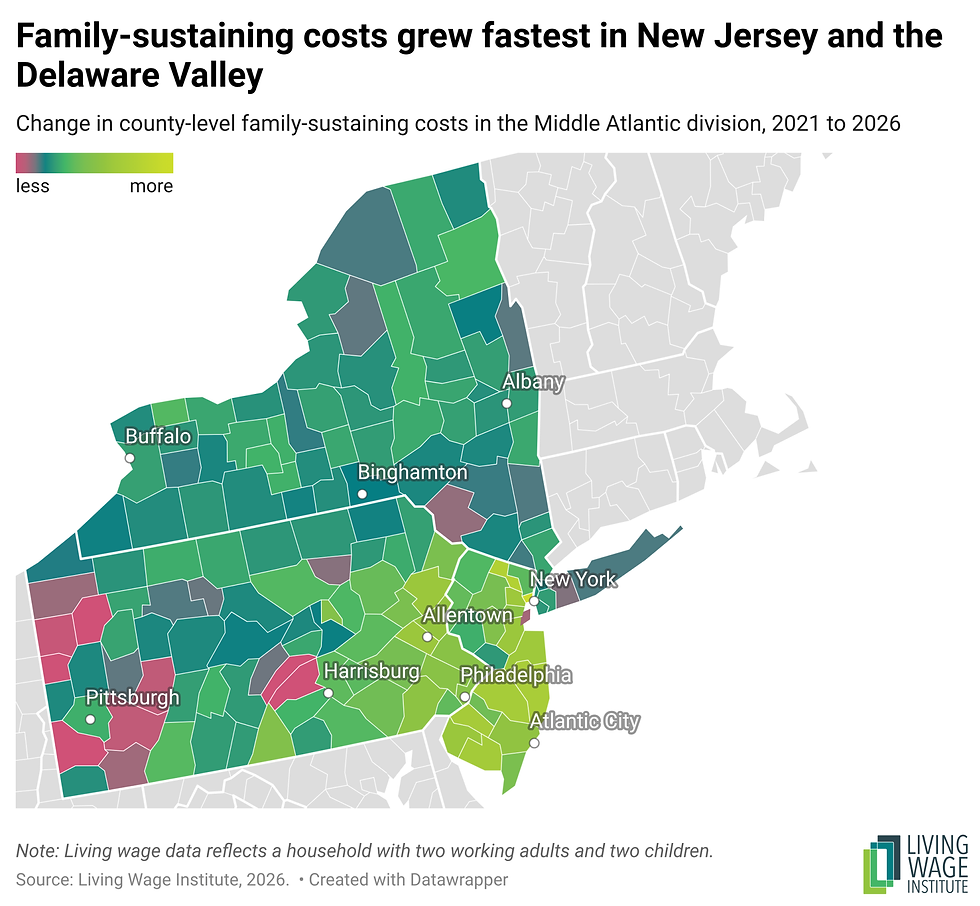
High cost pressures division-wide, but childcare growth patterns split by state
Differences in state-level family budget growth trace back to differing cost pressures. At the division level, healthcare costs have grown the fastest, rising 49.5% to $11,435 annually. Housing costs also grew by 41%—more rapidly than in either the Pacific or the West South Central divisions—adding more than $7,200 to family budgets since 2021.
Although housing and healthcare continue to drive budgets up, childcare is the top cost for a family in the division, growing by 22.7% over six years.
But childcare is also where state experiences diverge. This is especially true in New Jersey, where it remains the fastest-growing cost component. The typical New Jersey county saw childcare costs grow by 57%, far outpacing the 4.5% and 36.8% growth in New York and Pennsylvania counties, respectively. New York’s childcare costs vary by region: costs in New York City and its suburbs have grown slowly since 2021, while many upstate counties have seen costs grow by more than 15%. Healthcare and housing costs, by contrast, grew roughly in tandem across all three states, with only small differences in average cost growth.

Four local patterns behind cost growth
Division and statewide figures mask differences in local cost drivers. In a previous post, we identified six cost pressure typologies across all 3,144 U.S. counties.
More than half of the division's counties are high-cost metro counties, including New York City. In the high-cost metro typology, housing and childcare costs are both still rising, and childcare is nearly as expensive as housing, despite faster housing growth across most counties. In contrast, Philadelphia, southern New Jersey, and other counties in the Delaware Valley fall into the 15% of counties that have experienced outsized growth in childcare costs relative to other cost components. Childcare costs in Cumberland County, New Jersey, grew by roughly 90% since 2021, a pattern mirrored in northern New Jersey's Hudson and Essex counties.
Another 19% of counties, mostly stabilizing metro and suburban areas in shrinking regions of upstate New York, have seen housing costs largely peak. The remaining 13% of counties experienced more broad-based cost growth, with no single cost component standing out.

What this means for local employers
Across nearly every metro in the Middle Atlantic, a shrinking share of workers earn enough to sustain a family of four. In some places, for instance, Harrisburg, PA, Philadelphia, PA, and Pittsburgh, PA, that share fell by eight percentage points from 2021 to 2025, the steepest declines in the division. But what distinguishes each metro is the specific costs that drive living-wage gaps and the actions employers can take to support their workers.
In New York City, NY, Buffalo, NY, and Pittsburgh, family-sustaining costs grew significantly faster than wages. In all three metros, housing costs are rising faster than childcare costs, with rent growth outpacing childcare across most of the New York metro. Housing costs also dominate Albany, NY, but wages have kept pace with family cost growth, resulting in the smallest living wage gap in the division. Although wage gaps in these metros are smaller than in other locations, housing is the dominant cost driver, making wage competitiveness the primary lever to address workers’ most pressing needs.
In the Delaware Valley markets of Philadelphia, Allentown, PA, and Trenton, NJ, childcare is the single-largest family cost. Childcare cost growth is the primary driver of local living wage gaps, despite housing costs that grew at the division average. Childcare is also driving family budgets up in Binghamton, NY, although wages there have kept pace with costs, resulting in a smaller wage gap than in larger Rust Belt metros like Buffalo and Pittsburgh. Because childcare is the single-largest cost facing families across this group, targeted childcare benefits can be an effective lever for improving worker financial stability.
Harrisburg and Atlantic City are experiencing rapid growth in childcare and housing costs. In Harrisburg, housing slightly outpaced childcare growth, but childcare remains the more expensive cost due to its higher baseline. In Atlantic City, childcare growth significantly outpaced housing. Still, the wage gap there is so large—the largest in the division—that benefits alone won't be enough to close it.

Different cost pressures, different responses
Costs have outpaced wages across nearly all of the Middle Atlantic since 2021, but the pressures behind that gap aren't the same. In New York State and Pittsburgh, it is primarily housing opening up living wage gaps, while childcare is pushing up family budgets in the Pennsylvania and New Jersey counties in the Delaware Valley. For employers, understanding the local cost drivers putting pressure on their workers can help shape total rewards decisions: wage competitiveness when cost pressures are difficult to impact directly, while benefits can support workers when costs like childcare can be targeted directly.
Explore our data or connect with our team to factor our location-specific Wage Index database into your compensation planning, support workforce stability, and help address risks before they grow.
